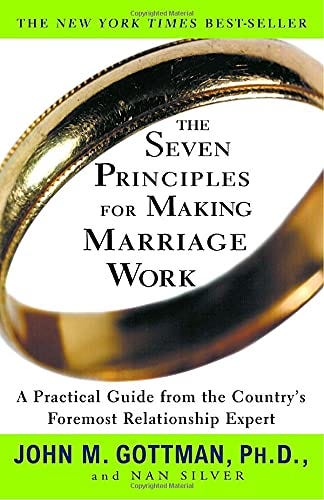
Dr. John Gottman, a therapist, and writer founded the Gottman Institute to support a research-based approach to marriages. He has spent decades studying couples to identify factors that correlate with divorce. Gottman and Nan Silver, in their book “The Seven Principles of Making Marriage Work, outline seven principles to help couples make their marriage work. In this book, the authors translate their research experience into practical advice for couples who want to repair or strengthen their relationships.
Gottman argues that the foundation for a happy marriage is a deep friendship with mutual respect and a positive attitude. He goes on to emphasize the importance of emotional intelligence in couples and marriages. He distinguishes between the misperception that love is a “feeling” and the reality that love is a “choice” that transcends the feeling of love. In describing his seven principles, Gottman outlines ways that couples can “choose” to increase intimacy, resolve conflict maturely, and build a meaningful life and marriage.
The Seven Principles
Gottman details seven principles for couples to follow to nurture their friendship and improve their marriage to help them endure challenging times. The seven principles include: enhancing their “love maps”; nurturing their fondness and admiration; turning toward each other instead of away; letting their spouse influence them; solving their solvable problems; overcoming gridlock; and creating a shared sense of meaning.
1. Share Love Maps: This is where all the information learned about our partners gets stored. The love maps can include things that your spouse likes and things that they dislike.
2. Nurture Your Fondness and Admiration: This shows that you care about your spouse and focus on and acknowledge their positive attributes and behaviors.
3. Turn Towards Each Other Instead of Away: This is doing things together and showing your spouse that they are valued. It is taking the time to listen.
4. Let Your Partner Influence You: This is sharing the decision-making and being willing to both make decisions and respect your spouse’s decisions.
5. Solve Your Solvable Problems: This is realizing which problems can be solved and solving them using skills for managing conflict, which includes: using Softened Startup, Repair and De-escalation, Physiological Self-Soothing, Accepting What You Cannot Change, Accepting Influence, and Compromise.
6. Overcome Gridlock: This is figuring out what is causing a block in your life and taking steps to overcome this block. It doesn’t necessarily mean fixing problems but taking steps to overcome them.
7. Create Shared Meaning: This is creating a life that is shared and meaningful for both of you.
The Four Horseman
Gottman also writes about the “Four Horseman” that are important to minimize and avoid: 1) criticism, 2) defensiveness, 3) contempt, and 4) stonewalling. Of these four, he warns that contempt is the highest predictor for divorce. He defines contempt as a spouse viewing themselves as better than the other spouse. Gottman defines criticism as attacking a spouse with complaints, defensiveness as usually a response to criticism that results in the defensive spouse criticizing the other, and stonewalling as being avoidant which can manifest itself in the silent treatment, leaving, and not being willing to properly communicate during contention.
The book is filled with helpful and insightful research and principles. The principles in the book are helpful and worth evaluating.
Recovering from Infidelity
If you have experienced infidelity-induced trauma caused by the emotional and sexual betrayal of your spouse, there is hope! If you are a child affected by parental infidelity, there is hope! If you are a spouse who has betrayed the trust, love, and fidelity of your marriage, there is hope! We recommend that you seek support through professional counseling and therapy as well as through groups dedicated to supporting you through this traumatic journey to recovery. You are not alone and recovery and healing are possible!
Share Your Story
The CHADIE Foundation shares personal stories of spouses and children impacted by infidelity and affairs. If you have a story you would like to share and have published, please use the contact information below to share your story with The CHADIE Foundation. Our mission is to help educate everyone about the damage infidelity, affairs, and adultery cause families and how to minimize the impact.
About the CHADIE Foundation
The CHADIE Foundation (Children are Harmed by Adultery, Divorce, Infidelity, and related Emotional trauma), helps spouses, partners, and children who adultery, affairs, and infidelity have negatively impacted. To learn more about CHADIE and how you can help, please email us at support@chadie.org or visit us at CHADIE.org.
 The CHADIE Foundation