
Not too long ago, we published an anonymously submitted letter written by a betrayed husband to his former cheating wife. No personally identifiable information was included in the article. No names, locations, events, etc. were included that could be used to identify, embarrass, or shame the betrayed husband or his betraying wife.
In the article, the author acknowledged that he ‘had made mistakes’ and ‘regretted their failed marriage.’ He didn’t suggest any of his mistakes or regrets were due to anything serious. However, he noted that his wife’s betrayal was unwarranted and unjustified which was the opposite of what she told their children. At the end of his letter, he wrote that he had forgiven her for her infidelity and betrayal and wished her happiness — hoping she would eventually be honest with their children.
Despite these facts, some readers took issue with the letter claiming the letter was ‘mean-spirited,’ ‘self-righteous,’ filled with ‘you’ statements, etc. Others disagreed. Interestingly enough, some of those who took issue with the letter suggested that because the author wasn’t faultless he ‘deserved’ to be cheated on. They proceeded to cast unfounded claims and accusations about him and his role in the demise of his marriage. They did this based on their misinterpretation of an anonymous letter.
While we could write about each of the unfounded accusations and attacks on the anonymous author, there is no need. However, a few main points need to be made since we are seeing a concerted effort to blame the betrayed rather than their betraying spouse.
One of the ‘mean-spirited’ accusations reads as follows:
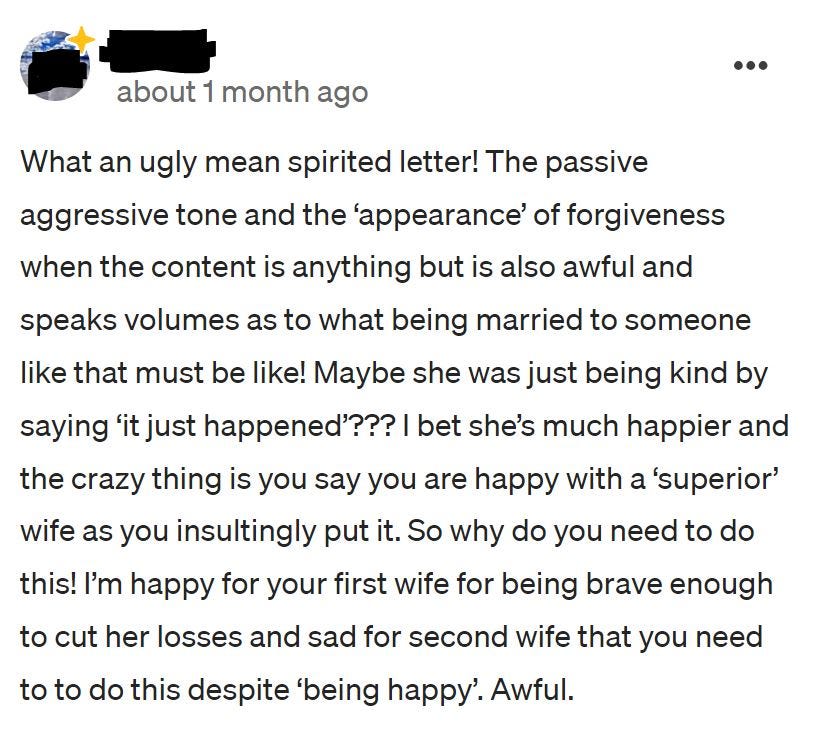
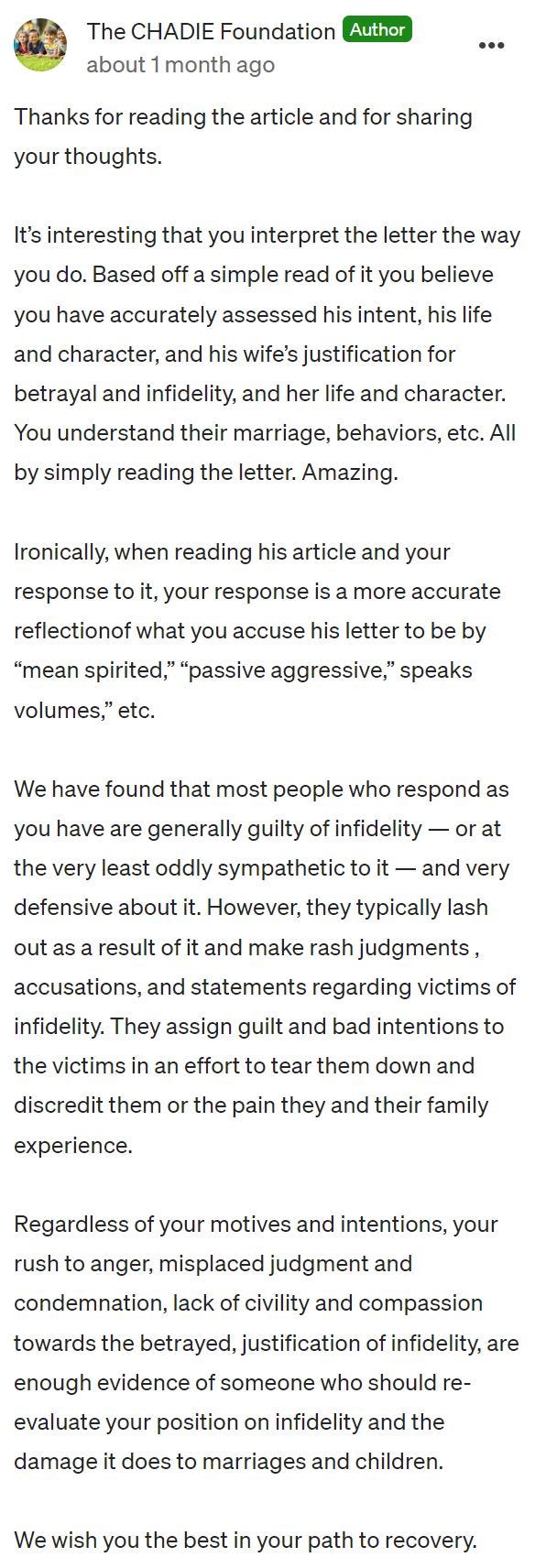
One of the ‘self-righteous’ accusations is as follows:
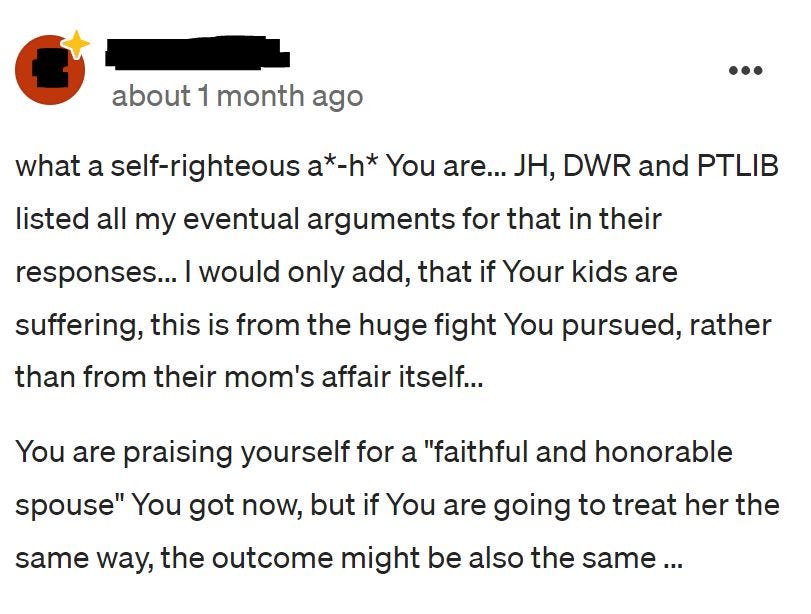
Those who read the article would likely be as confused by the above reply as we are. The reader’s response included comments about things not mentioned or referenced in the author’s letter. The response seemed slightly unhinged from reality. However, the responder to the article never responded to our reply.
Those who attacked the author for including ‘you’ statements about his cheating wife, attacked the author like this:
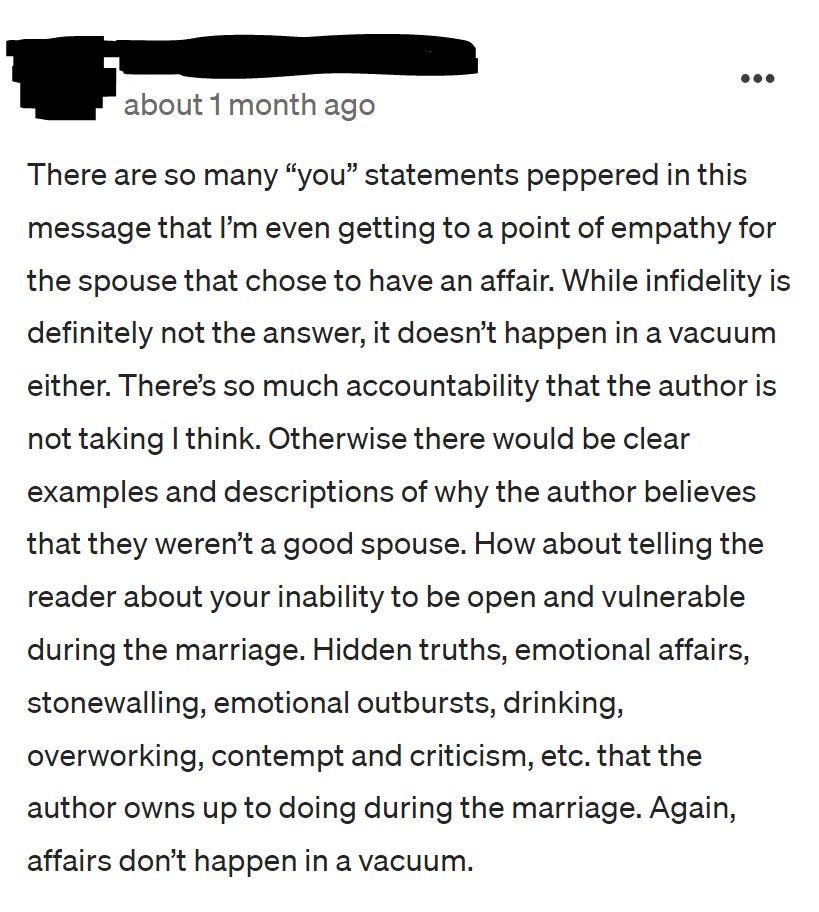
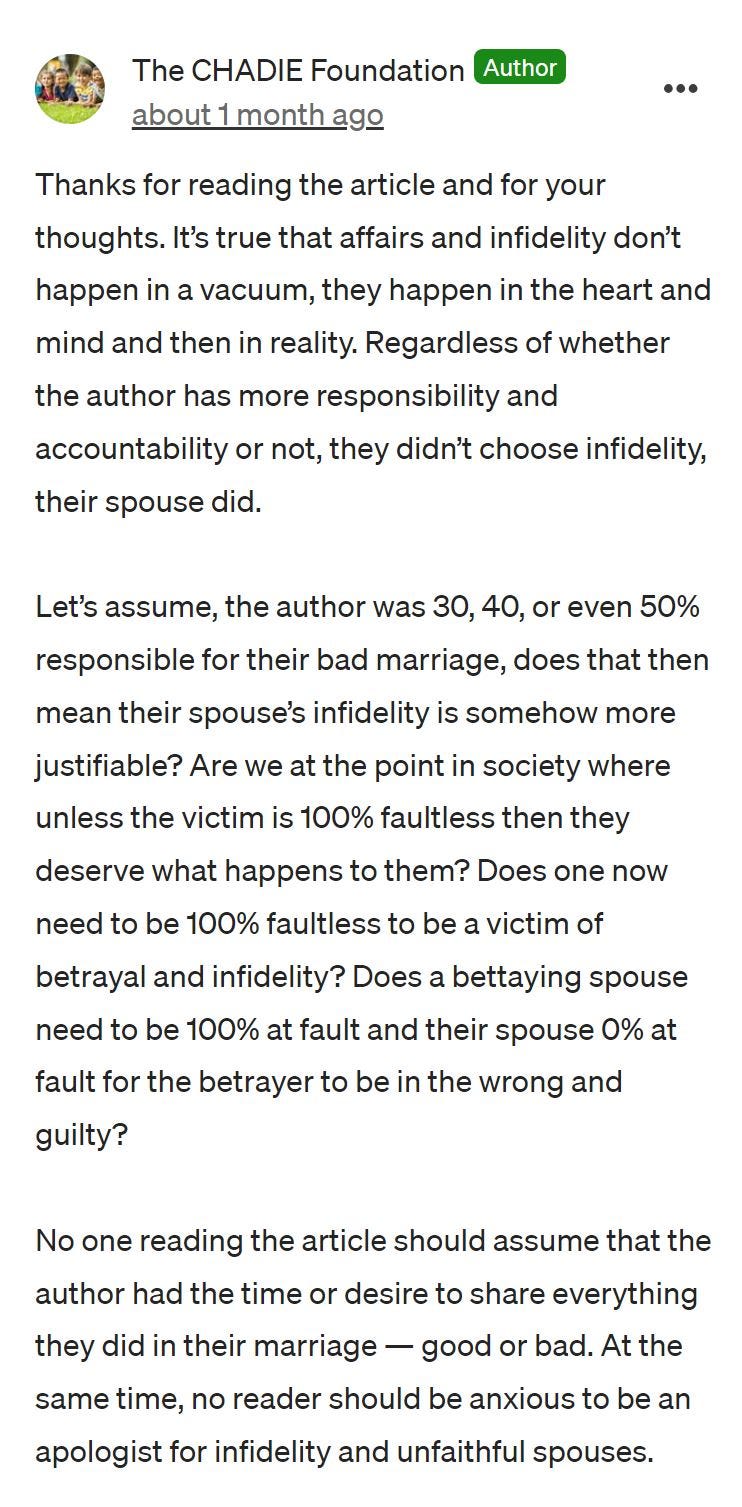
Not surprisingly, the reader never replied to our reply. However, herein lies the fault in their argument. They suggest that because the anonymous author had admitted to having personal faults in his marriage his wife was somehow justified in her infidelity and betrayal. So, we ask our readers, does a betrayed spouse need to be 100% guiltless in their marriage to be a victim of betrayal? Or, does the fact that they had some fault in an imperfect marriage mean they are not a victim of their spouse’s infidelity and betrayal?
As noted in one of our replies, “Let’s assume, the author was 30, 40, or even 50% responsible for their bad marriage, does that then mean their spouse’s infidelity is somehow more justifiable? Are we at the point in society where unless the victim is 100% faultless then they deserve what happens to them? Does one now need to be 100% faultless to be a victim of betrayal and infidelity? Does a betraying spouse need to be 100% at fault and their spouse 0% at fault for the betrayer to be in the wrong and guilty?”
What are your thoughts about all the ‘hate’ toward the betrayed?
Recovering from Infidelity
If you have experienced infidelity-induced trauma caused by the emotional and sexual betrayal of your spouse, there is hope! If you are a child affected by parental infidelity, there is hope! If you are a spouse who has betrayed your marriage’s trust, love, and fidelity, there is hope! We recommend that you seek support through professional counseling and therapy as well as through groups dedicated to supporting you through this traumatic journey. You are not alone and recovery and healing are possible!
Share Your Story
The CHADIE Foundation shares personal stories of spouses and children impacted by infidelity and affairs. If you have a story you would like to share and have published, please use the contact information below to share your story with The CHADIE Foundation. Our mission is to help educate everyone about the damage infidelity, affairs, and adultery cause families and how to minimize the impact.
About the CHADIE Foundation
The CHADIE Foundation (Children are Harmed by Adultery, Divorce, Infidelity, and related Emotional trauma), helps spouses, partners, and children who adultery, affairs, and infidelity have negatively impacted. To learn more about CHADIE and how you can help, please email us at support@chadie.org or visit us at CHADIE.org.
 The CHADIE Foundation