When We Deceive Ourselves, What Are the Costs?
(This is a contributed article.)
Have you ever spoken with someone you know is lying to you but has such conviction in what they are saying that you find yourself almost believing their lies? Or, you may have believed someone you later learned was lying to you. You may have wondered how they could have such strong convictions and be so convincing in their lying to be believable.
“Self-deception is a process of denying or rationalizing away the relevance, significance, or importance of opposing evidence and logical argument. Self-deception involves convincing oneself of a truth (or lack of truth) so that one does not reveal any self-knowledge of the deception.” (Source: Wikipedia)
Self-deception, or lying to oneself, is simply a motivated false belief. For many, false beliefs can satisfy important psychological needs of the individual. Self-deception can fool us into believing our lies — and even lead us to be more convincing. Self-deception can enhance self-image and self-importance.
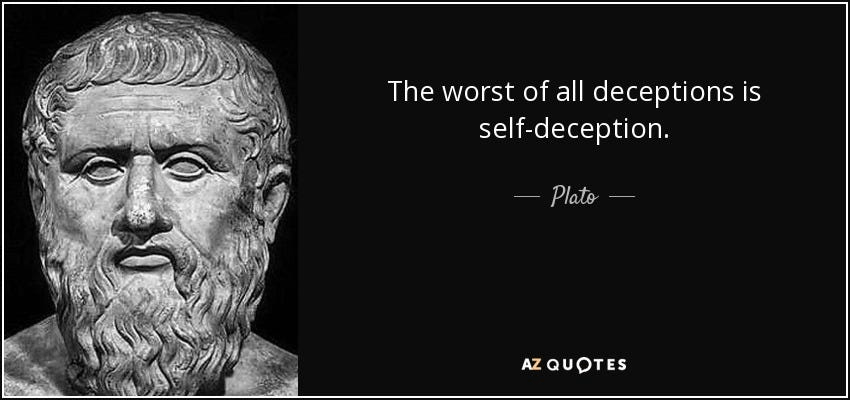
The worst of all deceptions is self-deception. — Plato
Often, our self-deception may be benign. When it is benign, it can lead us, unjustifiably, to feel more confident in ourselves. However, it’s always important to be aware of these tendencies — especially if we’re making potentially life-changing decisions. We don’t want to deceive ourselves about the risks of these potentially life-changing decisions.
If we’re honest, we would only hope that self-deception is a rare behavior. Merely, a phenomenon restricted to extreme situations. Unfortunately, it is quite common. We lie to ourselves to protect our self-images, which allows us to act unethically and even immorally while maintaining a clear conscience. One only needs to watch the news to see the media and entertainment filled with examples of this in government, politics, Hollywood, and business.
Too Close to Home For Comfort
While raising my family, my son took an interest in playing sports. We evaluated sports programs and coaching staff to find programs that would not only help reinforce hard work, mental toughness, teamwork, leadership, honesty, and strategy but build strong character too. After some time and effort, we found a program that provided these and more. The coach of the program had been coaching for many years and built a reputation in the community as a former accomplished player, award-winning coach, and a successful and wealthy businessman.
We met with the coach and he talked about the importance of building character in his players. He believed the sport was more than a game, it was a playbook for building strong, honest, ethical, and moral leaders. I was sold by his conviction and all of the external evidence of his integrity and commitment to what he said. After a few years, our son moved through this coach’s program advancing to the next level of the sport. Only a few years later did we find out that his former coach had been arrested for an elaborate business criminal scheme. For more than 10 years he had been embezzling, falsifying documents, lying to clients, stealing, etc. He had stolen millions and financially irreversibly impacted many people’s lives. To avoid justice, he abandoned his family, faked his death, and fled the country.
I still remember breaking this news to my son. It shattered his image of his coach. He had respected and admired his coach but this news left him wondering how his coach could have lived such a deceptive life.
Self-Deception is More Prevalent Than Ever
In many ways, we use our brains to convince ourselves to believe things that are not true. Self-deception allows us to inflate our opinions of our abilities — leading us to think we are smarter or better than everyone around us. Meaning, that we ignore the repercussions of our actions for other people. We do so believing we are acting morally. By deceiving ourselves about our beliefs, we increase our conviction in our opinions and ability to persuade others.
Unfortunately, we now see how self-deception impacts our society and marriages today. Many people have used platforms like Medium and social media to sell self-deception — claiming they ‘saved themselves through infidelity’ or that they are ‘a victim of a bad marriage’ and had ‘no other choice than to betray their spouse’ through infidelity.
As research is starting to uncover, some experts agree some married fraudsters can inhabit incredibly elaborate lies and self-deception. The findings suggest that some even show righteous anger when questioned about their self-deception. For some, a desire for social status may increase their tendency for self-deception.
How Do We Counter Self-Deception?
One way to cut through bias is to “consider the opposite” of our conclusions. To do this, we need to find where our beliefs are incorrect or false. This process is similar to cross-examining ourselves. Several studies have shown that this approach may lead us to think more analytically. In laboratory tests, this systematic reasoning proved much more effective than other common approaches.
By understanding the different factors contributing to self-deception, we can identify when it might be swaying our own decisions, and prevent these delusions from leading us into potentially life-changing decisions. Especially, when it comes to impacting our children.
(Sources cited or referenced for this article: BBC, Wikipedia, and Researchgate.)
Recovering From Infidelity
If you have experienced infidelity-induced trauma caused by the emotional and sexual betrayal of your spouse, there is hope! If you are a child affected by parental infidelity, there is hope! If you are a spouse who has betrayed the trust, love, and fidelity, there is hope! We recommend that you seek support through professional counseling and therapy as well as through groups dedicated to supporting you through this traumatic journey. You are not alone and recovery and healing are possible!
Share Your Story
The CHADIE Foundation shares personal stories of spouses and children impacted by infidelity and affairs. If you have a story to share and have published, please use the contact information below to share your story with The CHADIE Foundation. Our mission is to help educate everyone about the damage infidelity, affairs, and adultery cause families and how to minimize the impact.
About CHADIE Foundation
The CHADIE Foundation (Children are Harmed by Adultery, Divorce, Infidelity, and related Emotional trauma), helps spouses, partners, and children who adultery, affairs, and infidelity have negatively impacted. To learn more about CHADIE and how you can help, please email us at support@chadie.org or visit us at CHADIE.org.
 The CHADIE Foundation