The Marriage Readiness and Relationship Maturity Model (MRRM)

Marriage is one of the most meaningful and challenging commitments a person can make. Given its importance, how can you tell if you are ready for marriage? We’ve created a questionnaire to help you assess your readiness for marriage.
To ensure you and your partner are prepared for your marriage journey, this tool evaluates your readiness across eight critical dimensions: emotional stability, communication skills, shared values, financial preparedness, social dynamics, commitment, physical compatibility, and spiritual alignment.
By reflecting on your responses, you will better understand your strengths as a couple and the areas where growth may be needed. Each question is scored on a five-point Likert scale, with cumulative and category-specific results helping guide your next steps. This tool isn’t about judgment but about fostering insight and alignment for a successful, fulfilling partnership.
Take your time, answer honestly, and use the results as a stepping stone toward building a strong and lasting marriage.
How the Marriage Readiness and Relationship Maturity Model (MRRM) Works
- Answer the Questions Below: Respond to each question honestly using the Likert scale provided.
- Calculate Scores: Total your scores for each category and weight according to their importance.
- Review Insights: Receive feedback on your overall readiness and on specific categories to identify strengths and areas for growth.
Categories and Questions
Each category contains three questions answered on a five-point Likert scale: Strongly Agree (5), Agree (4), Neutral (3), Disagree (2), Strongly Disagree (1).
- Emotional & Psychological Readiness
- I am self-aware and understand my emotional triggers.
- I can manage stress and difficult emotions effectively.
- I feel emotionally stable and prepared for a long-term commitment.
2. Communication Skills
- I can openly express my thoughts and feelings to my partner.
- I actively listen to my partner without interrupting or judging.
- I feel confident resolving conflicts through discussion.
3. Shared Values & Goals
- My partner and I share similar life goals and aspirations.
- We have discussed and agreed on major values (e.g., family, work).
- We align on important decisions such as parenting and lifestyle.
4. Financial Readiness
- I have a clear understanding of my financial situation.
- I can discuss finances openly and transparently with my partner.
- My partner and I have agreed on a financial plan or budget.
5. Relational & Social Dynamics
- I feel comfortable with my partner’s social circle and family.
- My partner supports and respects my relationships with others.
- We maintain a healthy balance between individuality and togetherness.
6. Commitment & Conflict Resolution
- I am confident in my ability to stay committed during challenges.
- My partner and I resolve conflicts without damaging the relationship.
- We both value forgiveness and working through disagreements.
7. Physical & Sexual Compatibility
- I feel physically attracted to my partner.
- We openly discuss our physical and sexual needs and preferences.
- Our levels of physical affection and intimacy feel aligned.
8. Spiritual & Philosophical Alignment
- We share similar beliefs or respect each other’s differences.
- We have discussed how our spiritual or philosophical views impact life.
- I feel supported in my personal spiritual or philosophical journey.
Calculate Scores
Total your scores for each category and weigh them according to their importance.
Scoring Model
Likert Scale Responses:
- Strongly Agree: 5 points
- Agree: 4 points
- Neutral: 3 points
- Disagree: 2 points
- Strongly Disagree: 1 point
Category Weights
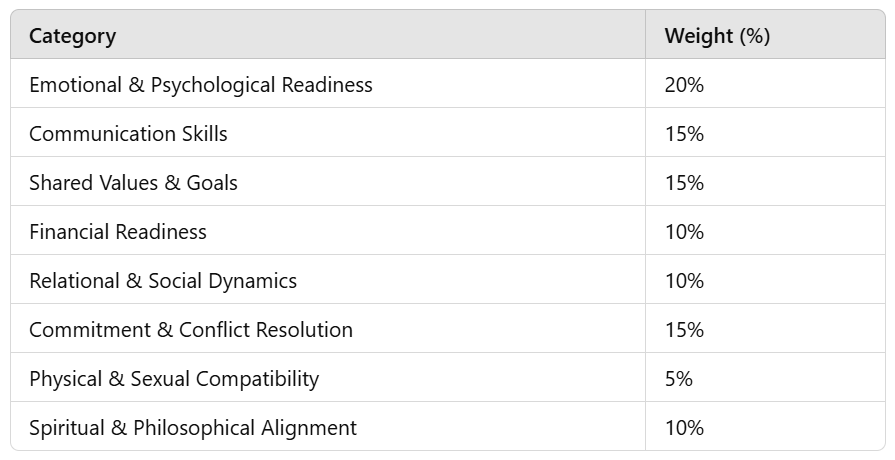
Scoring Tiers
Category-Specific Scoring Feedback:

Score Range Interpretation

Review Insights
Review feedback on your overall readiness and on specific categories to identify strengths and areas for growth.
Category-Specific Scoring Feedback
1. Emotional & Psychological Readiness
- 90–100%: You exhibit strong emotional awareness and stability, indicating excellent readiness to manage the personal and relational demands of marriage.
- 75–89%: You are emotionally prepared but may need to address minor triggers or improve stress management techniques.
- 50–74%: You show moderate emotional readiness, but challenges in managing emotions or stress may affect your relationship. Consider focusing on emotional self-regulation.
- Below 50%: Low emotional readiness. Developing self-awareness, emotional stability, and stress management skills should be a priority before committing to marriage.
2. Communication Skills
- 90–100%: Exceptional communication skills. You and your partner effectively share and resolve concerns, fostering a healthy dynamic.
- 75–89%: Solid communication abilities with some minor gaps. Work on improving specific areas, like active listening or conflict resolution.
- 50–74%: Communication challenges could lead to misunderstandings or unresolved conflicts. Practice clearer expression and active listening to strengthen this area.
- Below 50%: Poor communication skills may hinder marital success. Focus on learning techniques for open, respectful dialogue and conflict resolution.
3. Shared Values & Goals
- 90–100%: You and your partner align closely on major life values and goals, ensuring a strong foundation for shared decision-making.
- 75–89%: You share many values but may need deeper discussions about specific goals or decisions to avoid future conflicts.
- 50–74%: Moderate alignment in values and goals. Differences in priorities or unaddressed topics could cause friction.
- Below 50%: Major misalignments in values or goals. It’s crucial to have honest conversations about future aspirations and reconcile any discrepancies.
4. Financial Readiness
- 90–100%: Excellent financial readiness. You and your partner understand and agree on financial planning, budgeting, and transparency.
- 75–89%: Good understanding of finances, with minor areas to refine. Consider addressing specific budgeting or spending habits.
- 50–74%: Moderate readiness. Unresolved financial disagreements or lack of transparency could strain your relationship.
- Below 50%: Low financial readiness. Misaligned financial goals or poor financial literacy could lead to significant marital stress.
5. Relational & Social Dynamics
- 90–100%: You maintain a healthy balance between individuality and togetherness, with mutual respect for each other’s social circles.
- 75–89%: You manage social dynamics well, but minor adjustments in handling external influences or boundaries could strengthen your relationship.
- 50–74%: Moderate readiness. Challenges in balancing relationships with family, friends, and your partner need to be addressed.
- Below 50%: Significant issues in managing relational dynamics. These must be resolved to avoid external pressures negatively impacting your marriage.
6. Commitment & Conflict Resolution
- 90–100%: Strong ability to commit and resolve conflicts constructively, providing a reliable foundation for navigating challenges.
- 75–89%: Generally committed, with good conflict resolution skills. Minor areas of improvement could enhance your ability to navigate tough times.
- 50–74%: Moderate readiness. Your approach to conflict resolution may need refining to ensure long-term relational stability.
- Below 50%: Low readiness. Difficulty in managing conflicts or staying committed during hardships should be addressed before marriage.
7. Physical & Sexual Compatibility
- 90–100%: High compatibility in physical and sexual intimacy. You and your partner understand and respect each other’s needs.
- 75–89%: Good alignment, but minor discussions or adjustments around preferences could further enhance your connection.
- 50–74%: Moderate readiness. Differences in physical or sexual needs could create tension unless addressed openly.
- Below 50%: Significant misalignment. Addressing these issues is essential for maintaining intimacy and satisfaction in marriage.
8. Spiritual & Philosophical Alignment
- 90–100%: Strong alignment or mutual respect for each other’s spiritual or philosophical views, ensuring harmony in shared beliefs.
- 75–89%: Good alignment, with some minor differences. Open discussions can help maintain mutual respect and understanding.
- 50–74%: Moderate readiness. Discrepancies in beliefs could lead to friction unless openly discussed and respected.
- Below 50%: Significant misalignment in beliefs or lack of mutual respect. This could become a long-term challenge unless resolved.
Cumulative Scoring Feedback
90–100% (Excellent Readiness)
You and your partner exhibit strong compatibility and readiness across most areas. While minor adjustments may enhance your relationship, you are well-prepared for the commitment and challenges of marriage.
75–89% (Good Readiness)
You have a solid foundation, but there are some areas requiring attention. Address these concerns to further strengthen your relationship and prepare for long-term success.
50–74% (Moderate Readiness)
Your readiness for marriage is moderate. Significant effort is needed to address weaknesses, as unresolved issues in key areas could lead to challenges in your marriage.
Below 50% (Low Readiness)
Your current readiness level indicates significant challenges. It’s crucial to focus on improving weak areas and ensure alignment with your partner before committing to marriage.
Conclusion
Marriage is a journey that thrives on preparation, mutual understanding, and continuous growth. The Marriage Readiness and Relationship Maturity Model (MRRM) is designed to offer you valuable insights into your relationship’s strengths and potential areas for improvement. By reflecting on the results, you can better align with your partner and work together to build a strong foundation for your life together.
Remember, this questionnaire is not a pass-or-fail test but a guide to help you identify opportunities for growth and connection. Whether you score highly or discover areas that need attention, the most important step is to have honest, open conversations with your partner and take proactive steps toward a fulfilling and lasting marriage. Use this questionnaire as a starting point to deepen your understanding of yourself and your relationship, and embrace the opportunity to grow together.
Recovering From Infidelity
If you have experienced infidelity-induced trauma caused by the emotional and sexual betrayal of your spouse, there is hope! If you are a child affected by parental infidelity, there is hope! If you are a spouse who has betrayed your marriage’s trust, love, and fidelity, there is hope! We recommend that you seek support through professional counseling and therapy as well as through groups dedicated to supporting you through this traumatic journey. You are not alone and recovery and healing are possible!
Share Your Story
The CHADIE Foundation shares personal stories of spouses and children impacted by infidelity and affairs. If you have a story you would like to share and have published, please use the contact information below to share your story with The CHADIE Foundation. Our mission is to help educate everyone about the damage infidelity, affairs, and adultery cause families and how to minimize the impact.
About CHADIE Foundation
The CHADIE Foundation (Children are Harmed by Adultery, Divorce, Infidelity, and related Emotional trauma), helps spouses, partners, and children who adultery, affairs, and infidelity have negatively impacted. To learn more about CHADIE and how you can help, please email us at support@chadie.org or visit us at CHADIE.org.
 The CHADIE Foundation