Projecting the Rising Tide
In the past, infidelity was a shadow act; rare, stigmatized, and difficult to conceal. Today, it is a cultural undercurrent, aided by technology and rationalized by self-justification. If we trace the arc of rising acceptance and opportunity, we find ourselves staring down a future in which infidelity is no longer the exception but the norm.
Surveys consistently show a striking paradox: while over 85–90% of individuals still claim infidelity is morally wrong, a staggering 60–75% admit they would engage in it if they were guaranteed they wouldn’t get caught. This split between values and behavior is the quiet foundation of the infidelity epidemic, a societal cognitive dissonance where moral ideals crumble under the weight of convenience and secrecy.
From a predictive standpoint, if infidelity among married individuals has hovered around 16–25% for decades but is now increasingly facilitated by private messaging, emotional affairs, and “gray area” betrayals (e.g., sexting, micro-cheating, virtual liaisons), the actual number of relational betrayals, broadly defined, is far higher.
If current social and technological trends continue, we could plausibly see:
- Infidelity in some form (physical or emotional) is expected to affect 30–40% of marriages by the 2030s.
- Virtual infidelity (e.g., pornography addiction, emotional texting, online relationships) is becoming normalized in over 50% of partnerships.
- A significant generational divide, with Gen Z and Gen Alpha embracing “relationship fluidity” and viewing monogamy as a niche lifestyle.
This prediction is not just a reflection of weakness, but of shifting design. The very architecture of modern life — algorithmic matchmaking, endless novelty, and immediate gratification — rewards impulsivity over discipline and commitment. And with fewer societal or religious guardrails, the boundaries around commitment are increasingly seen as optional.
In this projected future, marriage will continue to exist, but its meaning will splinter. For some, it will remain a sacred and committed union. For others, it will be a renewable emotional contract, re-negotiated as needs evolve. And for many, it will be avoided, a relic of a time when people still believed in permanence.
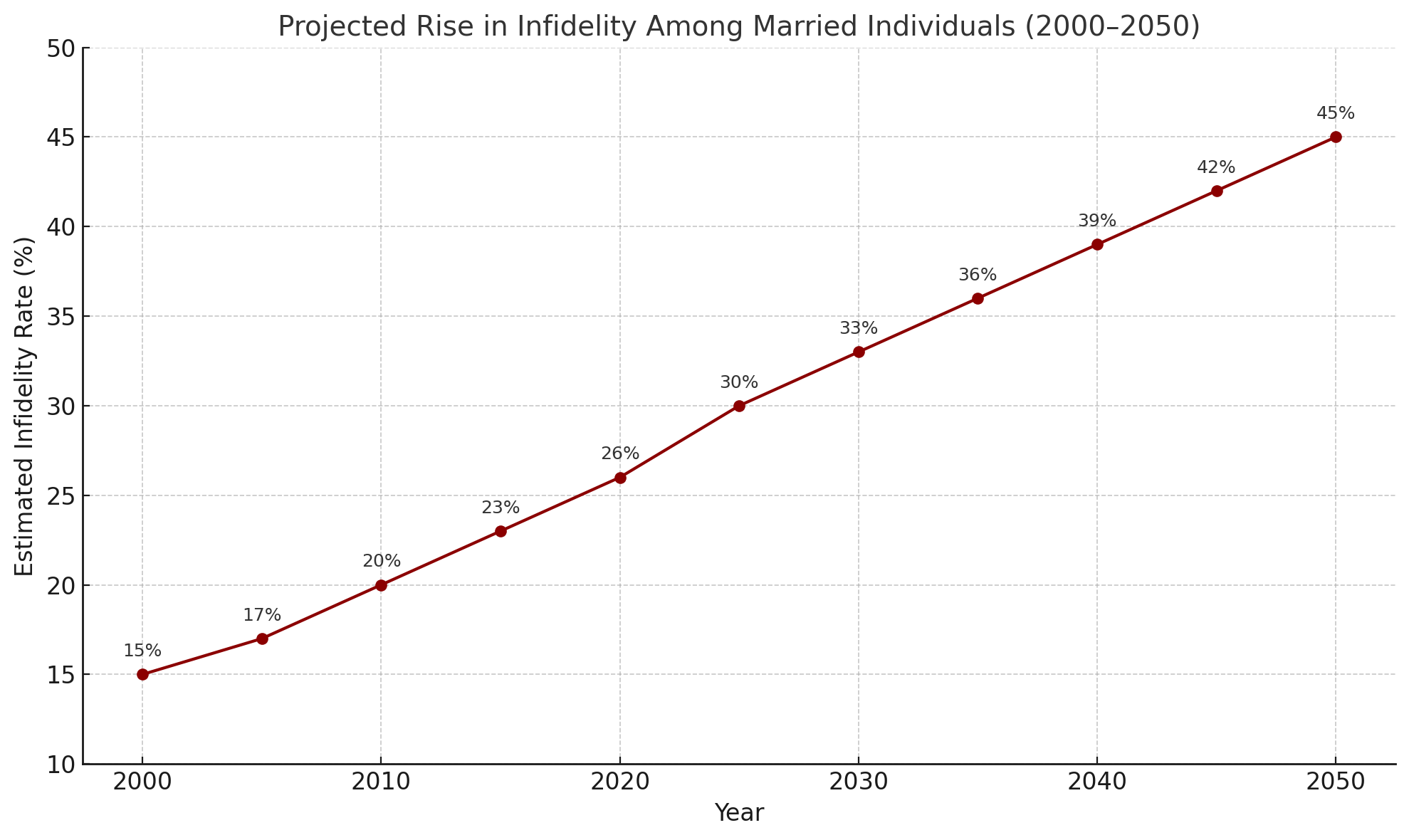
Here’s a visual projection of the rise in infidelity among married individuals from 2000 to 2050:
This chart illustrates a hypothetical but plausible trend based on current data and behavioral patterns, showing a steady increase in infidelity rates, potentially reaching 45% by mid-century if current societal shifts continue. (This projection is based on current data available. Given the nature of infidelity and its secrecy, the stats available today are likely understated.)
The Next Generation: Echoes of Collapse
By 2040 or 2050, if trends continue unchecked, we may find ourselves in a paradox:
- A world more “connected” than ever, yet emotionally disconnected.
- Children are raised more by screens than by stable parents.
- A culture of self-optimization that prizes individual fulfillment at the cost of relational endurance.
And the consequence? A legacy not of progress, but of emotional erosion.
Many will likely look back thinking they were freeing themselves from rules. But in the ashes of broken vows and blended pain, they will learn that the covenant wasn’t a prison; it was a shelter.
Recovering From Infidelity
If you have experienced infidelity-induced trauma caused by the emotional and sexual betrayal of your spouse, there is hope! If you are a child affected by parental infidelity, there is hope! If you are a spouse who has betrayed your marriage’s trust, love, and fidelity, there is hope! We recommend seeking support through professional counseling and therapy, as well as dedicated groups supporting you through this traumatic journey. You are not alone, and recovery and healing are possible!
Share Your Story
The CHADIE Foundation shares personal stories of spouses and children impacted by infidelity and affairs. If you have a story you would like to share and have published, please use the contact information below to share your story with The CHADIE Foundation. Our mission is to help educate everyone about the damage infidelity, affairs, and adultery cause families and how to minimize the impact.
About CHADIE Foundation
The CHADIE Foundation (Children are Harmed by Adultery, Divorce, Infidelity, and related Emotional trauma) helps spouses, partners, and children who adultery, affairs, and infidelity have negatively impacted. To learn more about CHADIE and how you can help, please email us at support@chadie.org or visit us at CHADIE.org.
 The CHADIE Foundation